


onlyswim
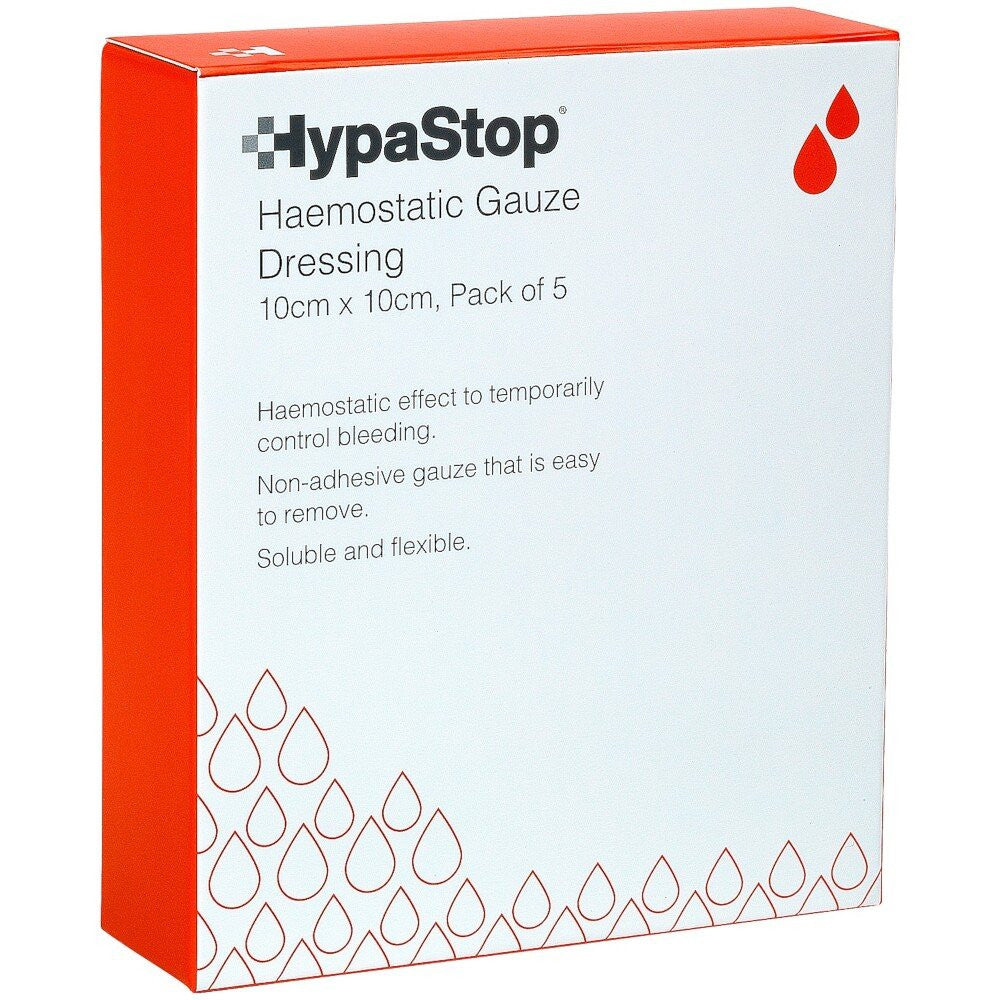
HYPASTOP HAEMOSTATIC GAUZE 10 x 10cm (Pack of 5)
HYPASTOP HAEMOSTATIC GAUZE 10 x 10cm (Pack of 5)
SKU: FA360
Low stock: 10 left
Couldn't load pickup availability

Details
For severe trauma bleeds, haemostatic gauze is a life-saving tool — particularly in emergencies, field settings, or mass casualty events where time and blood are both critical, regular dressings are not enough when seconds matter…
- Stops severe and life-threatening bleeding in minutes
- Easy to use for fast emergency application
- More effective and quicker clotting than regular dressings
- Sterile, individually wrapped dressings
- Safe - no side effects
- Size 10cm x 10cm (pack of 5)
Our HypaStop Haemostatic Gauze (also known as a dressing) is designed to stop major bleeds fast by encouraging the clotting process to start within minutes of application.
This pack comes with five HypaStop Haemostatic Gauzes, each individually wrapped to ensure first aiders have immediate access to sterile gauze.
How Does HypaStop Haemostatic Gauze Work?
Haemostatic gauze kick starts the body's natural clotting process through a chemical reaction. This is accomplished when the haemostatic agent in the gauze imitates a chemical that is required for the clotting process.
This agent is drawn into the blood stream and starts the clotting that would occur naturally, meaning that the wound will close more rapidly than if the casualty were to wait for their body to create the chemical itself.
What Agent is the Active Ingredient?
Sodium carboxymethyl cellulose (Na-CMC) is used in our HypaStop Haemostatic Gauze to accelerate clot formation by increasing blood viscosity and creating a viscous gel. Unlike alternative haemostatic dressings, it doesn’t use chitosan, a fibrous substance found in the exoskeletons of crustaceans like shrimp, crabs, and lobsters, as well as in the cell walls of some fungi and insects.
How to Use HypaStop Haemostatic Gauze
Even with no official first aid training, the HypaStop Haemostatic Gauze is simple to use. It can be administered for either shallow cuts or for deeper wounds.
To use the gauze for shallow cuts, it should be held against the wound while maintaining pressure, either manually or through the use of a bandage. While for deeper wounds, the gauze may need to be packed inside the incision before being secured into place.
Haemostatic gauze should not be used for:
- A patient's airway or chest
- A patient's eyes
- Any serious head injury which exposes brain tissue
Reasons to Choose Haemostatic Gauze for Severe Trauma Bleeds
- Rapid Clot Formation
- Haemostatic gauze contains agents that accelerate the body’s natural clotting.
- This gauze stops life-threatening bleeding in under 3 minutes, much faster than regular gauze.
- Effective on Arterial Bleeds
- Specifically designed to control arterial and junctional haemorrhages, which are often not manageable with standard gauze alone.
- Used by Military and First Responders
- Proven in combat and pre-hospital emergency care where massive bleeding is common.
- Recommended in Tactical Combat Casualty Care (TCCC) and civilian trauma protocols.
- Works When Pressure Alone Fails
- Haemostatic gauze often makes the difference between life and death when a tourniquet is not viable (e.g., groin, neck, axilla), by enhancing the effect of direct pressure.
- Reduces Blood Loss
- Being able to control the bleeding faster reduces overall blood loss, increasing the patient’s chance of survival and reducing the risk of complications like hypovolemic shock.
- Easy to Use Under Stress
- Designed for quick and easy use, even in high-pressure situations by non-medical personnel (e.g., in civilian trauma kits or stop-the-bleed kits).
- Clinically Tested
- Haemostatic Gauze products are backed by clinical studies showing higher success rates than traditional gauze in controlling haemorrhage.
Limitations of Regular Dressing (Standard Gauze)
- As they rely solely on mechanical pressure and natural clotting, it is often too slow for major bleeds.
- Regular dressings are less effective on deep wounds or wounds in non-compressible areas.
- They can quickly become soaked through, requiring frequent changes or additional material.
- Standard gauze isn't formulated for active bleeding control, it's more appropriate for minor injuries or post-haemostatic dressing.
Bottom Line:
For severe trauma bleeds, haemostatic gauze is a life-saving tool — it is essential in emergencies, field settings, or mass casualty events where time and blood are both critical. Regular dressings are not enough when seconds matter.
What you cover in your shipping policy and how you communicate it will be highly dependent on your current business operations and supply chain. The goal is to be transparent with customers.
As 2020 brings unforeseen shipping delays and increased carrier costs, it's more important than ever to keep your shipping policy up to date with the following key points in mind:
- Essential shipping details are easy to find. While it is common practice to keep a link to your shipping policy page in the footer of your website, consider how you can also surface important shipping details in the right place at the right time (e.g. on your product page or website banner).
- Clear and concise presentation. Don’t make customers comb through your shipping policy page for the information they need. Whenever possible, make it easy to navigate with clear subheadings, tables, bolded text, and links to learn more.
- Order processing times. After an order is placed, how many days will it take to get it ready to ship? It’s worth communicating if you’re excluding weekends and/or holidays, and if you have certain cutoff times for processing orders (e.g. orders received after 5pm will be processed the next business day). If changes occur within your supply chain, due to peak periods or as a result of COVID-19, you should update your processing times to reflect it.
- Domestic and international shipping options. What are the qualifying regions for your domestic shipping options? International shipping can be broken down in its own section where you list the countries you ship to and estimated delivery timelines. If you offer several shipping options, you can list them in a table so the information is easy to scan. Shipping costs. Break down your shipping costs for the customer. If you have a free shipping threshold, you can communicate in various places as an incentive for customers. Any potential surprise fees should be surfaced too, such as duties and taxes the customer may incur.
| Title |
Default Title |
|---|